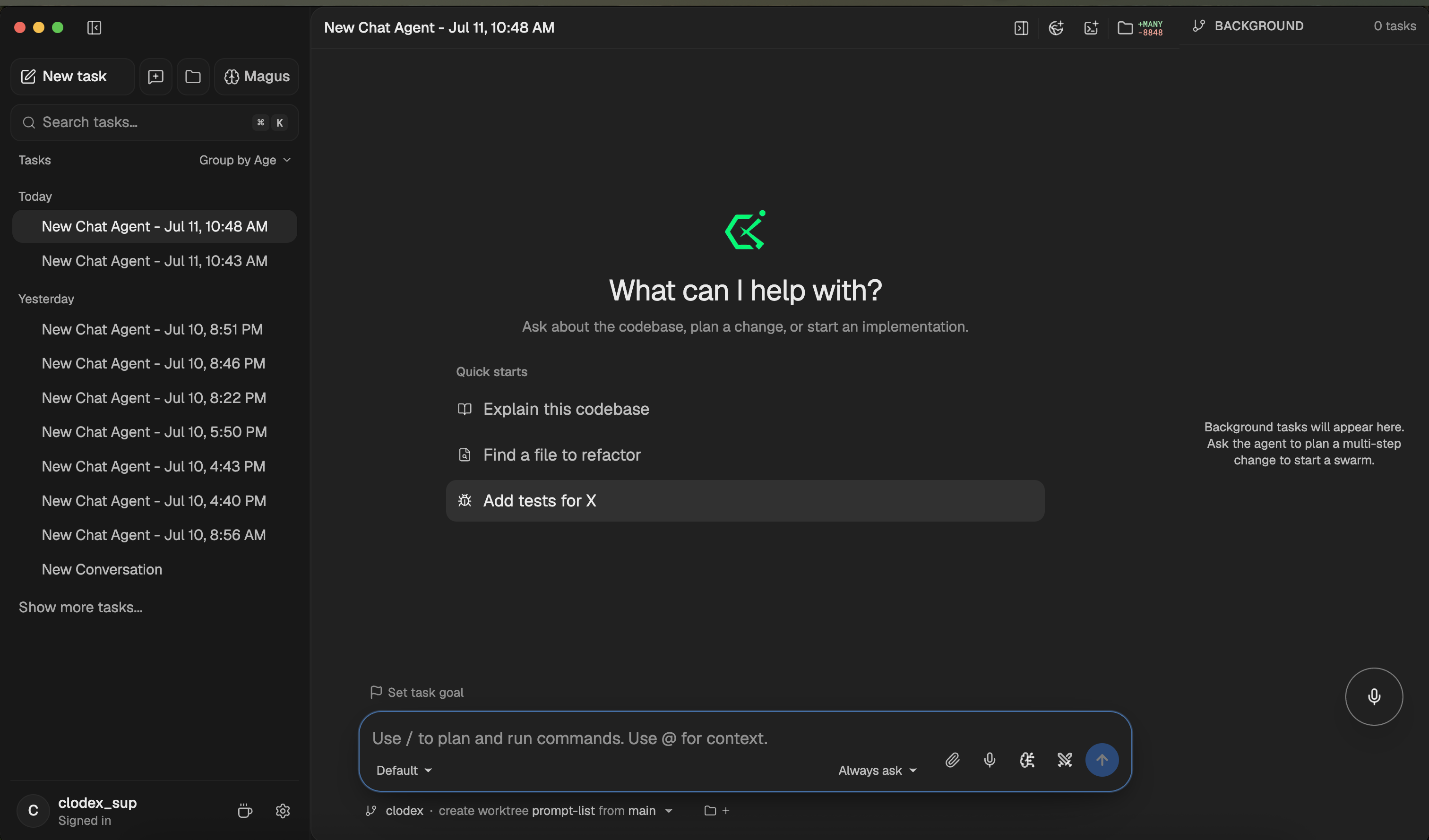
Clodex is an open-source, local-first agentic development environment for
governed software work. It combines durable AI tasks, code and Git tools,
terminal, browser, memory, model routing, and controlled execution in one
Electron workspace. Local testing does not require a Clodex account: use your
own provider API key, a custom OpenAI-compatible endpoint, or a local Ollama
runtime.
It is an early-stage, solo-led research and engineering project. The current
Technical Preview is intended to validate architecture and real workflows; it
is not presented as a production-mature IDE or an established community.
It is built around a simple principle:
Model output is untrusted input. Authority comes from explicit policy,
isolated runtimes, and user-controlled review.
Current release status: Technical Preview. The architectural core is
implemented and tested locally. The public desktop binaries described below
are unsigned community test artifacts, not an official stable release.
Advanced execution lanes remain feature-gated until their live promotion
evidence and manual sign-off are complete.
Community test build
The current public tester build is 1.16.0-communityobserved7, produced from the
canonical main commit
981311304fb4c648ebbaa0b85fbed0602aab2c9f
by GitHub Actions run 29615260553
and published as a clearly separated
GitHub community prerelease.
It adds the Русский (beta) interface and a required first-launch privacy
choice with Allow anonymous statistics as the primary action and a visible
Continue without statistics path. The previous
community4 prerelease
remains available as the telemetry-free predecessor.
Download SHA256SUMS.txt
from the same prerelease and verify the installer before opening it. The exact
source manifests, CycloneDX SBOMs, warnings, platform validation reports, and
byte-level audit report are retained in the compact
evidence archive.
Do not use repackaged binaries from an unverified mirror.
Before onboarding, the build requires an explicit allow-or-decline choice. No
PostHog client starts before that decision. If anonymous statistics are
allowed, only the backend client may send allowlisted counters, bounded timing,
enum metadata, app/platform metadata, and a pseudonymous installation ID.
Renderer capture, person profiles, GeoIP enrichment, prompts, messages, source
code, commands, paths, URLs, API keys, tool arguments, error or feedback text,
exceptions, account identification, session recording, full telemetry, and AI
tracing are disabled. The choice can be changed later in Settings.
Verify and install
Community packages intentionally have no trusted publisher identity. macOS
apps are ad-hoc signed and not notarized, Windows packages are not
Authenticode-signed, and Linux packages have no CLODEx release signature.
Open source makes the source inspectable; it does not authenticate a downloaded
binary.
Confirm that the bundle manifest records the expected version, platform,
architecture, and source commit.
Verify the selected file before installation. For example:
# macOS: replace FILE with the downloaded DMG name
grep "  FILE$" SHA256SUMS.txt | shasum -a 256 -c -

# Linux: replace FILE with the downloaded DEB or RPM name
grep "  FILE$" SHA256SUMS.txt | sha256sum -c -
On Windows, compare Get-FileHash <installer.exe> -Algorithm SHA256 with
the installer entry in SHA256SUMS.
Install for your platform:
macOS: open the matching DMG and drag the app to /Applications. On
first launch, use Finder's per-app Control-click -> Open review only
after verifying the bundle. Do not disable Gatekeeper globally.
Windows: run the x64 setup. SmartScreen may warn about an unknown
publisher; use only its per-file review path after verifying the bundle.
Do not disable SmartScreen or Defender globally.
Linux: install either the downloaded DEB (apt install ./<file>.deb)
or RPM (rpm -i ./<file>.rpm) for your distribution.
The observed community build has a separate application identity. Account
sign-in, auto-update, and default protocol registration are excluded. The
first-launch privacy choice must be completed before normal IDE use. Install
newer community builds manually.
First launch: connect a model
Choose System, English, or Русский (beta) in onboarding or
Settings -> General, then restart once to verify persistence.
Leave anonymous telemetry off, or explicitly opt in after reviewing the
description in onboarding or settings.
Open a local project or workspace.
In onboarding or Settings -> Models & Providers, choose one of:
a BYOK API key for a supported provider such as OpenAI, Anthropic, or
Google;
a custom OpenAI-compatible endpoint; or
local Ollama, normally at http://localhost:11434.
Test the connection, select a discovered model, and start a small task.
Provider usage and billing remain between you and the provider. Never include
API keys, tokens, private source, or unredacted logs in an issue or tester
report. See the full
community unsigned build policy and
support guide.
Clodex began as a modified version of the open-source Stagewise codebase and
has since diverged into an independently maintained project focused on
governed execution, evidence, policy enforcement, model routing, runner
isolation, and session continuity.
The exact upstream base commit, reproducible diff method, Clodex-specific
systems, and continuing upstream-derived areas are documented in
CLODEX_VS_UPSTREAM.md. Upstream copyright and
license notices are preserved in
THIRD-PARTY-NOTICES.md. Clodex is not affiliated
with or endorsed by Stagewise.
Why Clodex
A conventional coding assistant produces the next answer or patch. Clodex
models engineering work as a durable task with its own state, workspaces,
processes, permissions, evidence, and review lifecycle.
A task can:
retain context across long-running work and application restarts;
operate across files, Git, terminals, browser tabs, MCP tools, and runners;
route work between models without changing the surrounding workflow;
request approval before high-impact shell, network, browser, or remote
actions;
execute locally or move to Docker, SSH, or cloud-backed environments;
return diffs, receipts, artifacts, and a self-contained final result.
Core capabilities
Area
What Clodex provides
Persistent tasks
Searchable task history, projects, workspaces, forks, goals, progress, token budgets, and time budgets.
Agent runtime
Managed turns, cancellation, recovery, collaboration modes, tool execution, and supervised lifecycle handling.
Clodex does not rely on a prompt asking the model to behave safely. Sensitive
operations pass through deterministic controls outside the model runtime.
Fail closed: ambiguous or invalid authorization results do not execute.
Isolated hosts: agent turns, MCP servers, and sandboxed workloads run
outside the renderer.
Explicit capabilities: possessing a tool does not automatically grant
authority to use it.
Controlled egress: network destinations are evaluated independently of
model intent.
Protected storage: credentials use OS-backed storage; sensitive task
artifacts use context-bound authenticated encryption.
Human review: pending edits, permission prompts, protected merge flows,
and high-impact approvals keep final authority with the user.
Supply-chain checks: extension identity, signatures, integrity,
compatibility, rollback, and quarantine are verified before activation.
Privacy-aware audit: operational events avoid storing prompts, source
code, audio, credentials, or other unnecessary sensitive content.
Desktop workspace, files, Git, terminal, and browser
Available for local testing
Task lifecycle, goals, scoped memory, and recovery
Available for local testing
MCP runtime and isolated Agent Host
Available for local testing
Local and SSH execution
Available for local testing
Docker and external runner control plane
Preview
Guardian and managed network egress
Preview
Signed extensions and generated apps
Preview
Cloud Tasks and Session Teleport
Labs / promotion-gated
Unsigned macOS, Windows, and Linux community builds
Available for public testing
Official signed cross-platform distribution
Pending promotion evidence
The status labels are deliberate: implemented foundations are not presented as
stable production capabilities until real installation evidence, monitoring,
rollback, and manual promotion checks are complete.
Use the checked development command when you want type checking to run in
parallel with Electron:
pnpm --dir apps/browser start
Environment and provider configuration are documented in
docs/developer/local-development.md.
Never commit .env, credentials, signing keys, or local runtime state.
Validation
Run the complete local validation suite before opening a pull request:
pnpm check
pnpm typecheck
pnpm test
pnpm security:secrets
Run formatting, type checking, tests, and secret scanning.
Include focused tests for changed behavior.
Use the repository issue templates for bugs, feature proposals, documentation,
installation and provider problems, security questions, and independent tester
reports. Use GitHub Discussions for design questions and community proposals.
The contributor trust ladder, maintainer responsibilities, and access policy
are defined in GOVERNANCE.md. Scoped compute grants and
longer-term collaboration paths are described in
COLLABORATE.md.
Maintainers and community
Clodex is currently maintained independently by
Merey Abdenbekuly and welcomes
external contributors, testers, security reviewers, research collaborators,
and integration partners. Current roles and upstream credits are listed in
CONTRIBUTORS.md.
If Clodex is useful to you, the current support options and their terms are
listed on the Clodex website. Financial
support does not buy roadmap priority, repository access, or merge decisions.