跳到主要内容7 个经典 Python 爬虫实战案例与代码解析 | 极客日志Python算法
7 个经典 Python 爬虫实战案例与代码解析
通过七个实战案例演示了 Python 爬虫的核心技术,涵盖正则表达式、XPath、BeautifulSoup、Selenium 及 API 接口分析。内容包含百度贴吧评论抓取、小说章节多线程存储、豆瓣电影榜单解析、电商评论动态加载处理、知乎模拟登录搜索、微博数据获取以及票房数据分析可视化。教程提供完整代码示例,并强调反爬策略应对、数据清洗及合规使用的重要性,适合初学者系统学习网络数据采集流程。
忘忧96 浏览 7 个经典 Python 爬虫实战案例与代码解析
本文通过七个实战案例演示了 Python 爬虫的核心技术,涵盖正则表达式、XPath、BeautifulSoup、Selenium 及 API 接口分析。内容包含百度贴吧评论抓取、小说章节多线程存储、豆瓣电影榜单解析、电商评论动态加载处理、知乎模拟登录搜索、微博数据获取以及票房数据分析可视化。教程提供完整代码示例,并强调反爬策略应对、数据清洗及合规使用的重要性,适合初学者系统学习网络数据采集流程。
环境准备
在开始之前,请确保已安装以下 Python 库:
pip install requests lxml beautifulsoup4 selenium pymysql pandas matplotlib
若使用 Selenium,还需下载对应浏览器的驱动(如 chromedriver.exe)并配置环境变量。
1. 使用正则表达式和文件操作爬取并保存帖子回复内容
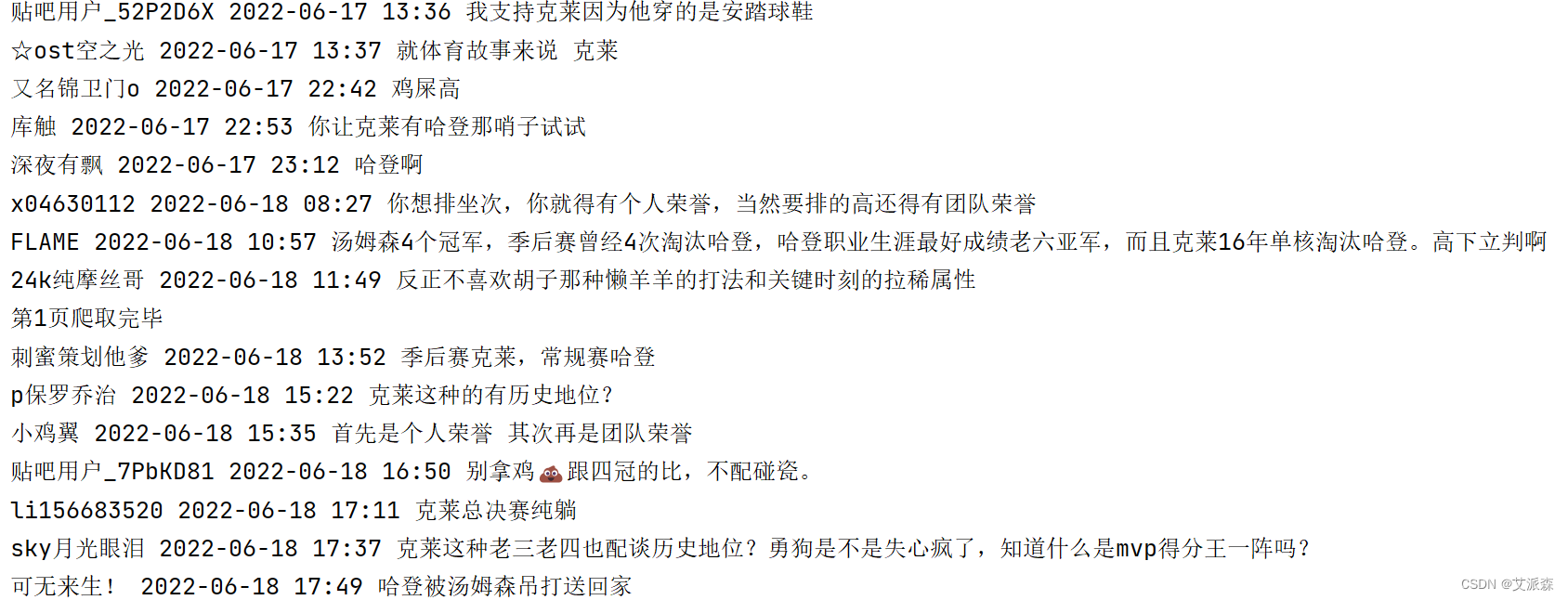
本案例选取百度贴吧中的帖子,目标是爬取帖子里面的回复内容。涉及知识点:requests 请求发送、re 正则匹配、csv 文件写入。
关键步骤:
- 构造带有分页参数的 URL。
- 设置 User-Agent 伪装浏览器。
- 使用正则提取用户名、时间和评论内容。
- 过滤异常数据(如包含图片链接的无效文本)。
- 循环爬取多页并保存至 CSV。
源代码:
import csv
import requests
import re
import time
def main(page):
url = f'https://tieba.baidu.com/p/7882177660?pn={page}'
headers = {
'User-Agent': 'Mozilla/5.0 (Windows NT 10.0; Win64; x64) AppleWebKit/537.36 (KHTML, like Gecko) Chrome/106.0.0.0 Safari/537.36'
}
resp = requests.get(url, headers=headers)
html = resp.text
comments = re.findall('style="display:;"> (.*?)</div>', html)
users = re.findall('class="p_author_name j_user_card" href=".*?" target="_blank">(.*?)</a>', html)
comment_times = re.findall('楼</span><span class="tail-info">(.*?)</span><div', html)
for u, c, t in zip(users, comments, comment_times):
if 'img' c c (u) > :
csvwriter.writerow((u, t, c))
(u, t, c)
()
__name__ == :
(, , encoding=) f:
csvwriter = csv.writer(f)
csvwriter.writerow((, , ))
page (, ):
main(page)
time.sleep()
in
or
'div'
in
or
len
50
continue
print
print
f'第{page}页爬取完毕'
if
'__main__'
with
open
'01.csv'
'a'
'utf-8'
as
'评论用户'
'评论时间'
'评论内容'
for
in
range
1
8
2
2. 实现多线程爬虫爬取小说章节内容并以数据库存储
本案例选取笔趣阁小说网,目标爬取第一篇小说的前 15 个章节内容并存储到 MySQL 数据库。涉及知识点:XPath 解析、多线程并发、MySQL 连接池。
- 分析网页结构,定位章节列表节点。
- 封装 HTTP 请求函数,复用 Headers。
- 使用 XPath 提取章节标题和链接。
- 进入详情页,使用正则清洗正文内容。
- 建立数据库连接,执行插入语句。
- 使用 ThreadPoolExecutor 创建线程池提高爬取效率。
import requests
from lxml import etree
import re
import pymysql
from time import sleep
from concurrent.futures import ThreadPoolExecutor
def get_conn():
conn = pymysql.connect(host="127.0.0.1",
user="root",
password="root",
db="novels",
charset="utf8")
cursor = conn.cursor()
return conn, cursor
def close_conn(conn, cursor):
cursor.close()
conn.close()
def get_xpath_resp(url):
headers = {'User-Agent': 'Mozilla/5.0 (Windows NT 10.0; Win64; x64) AppleWebKit/537.36 (KHTML, like Gecko) Chrome/106.0.0.0 Safari/537.36'}
resp = requests.get(url, headers=headers)
tree = etree.HTML(resp.text)
return tree, resp
def get_chapters(url):
tree, _ = get_xpath_resp(url)
novel_name = tree.xpath('//*[@id="info"]/h1/text()')[0]
dds = tree.xpath('/html/body/div[4]/dl/dd')
title_list = []
link_list = []
for d in dds[:15]:
title = d.xpath('./a/text()')[0]
title_list.append(title)
link = d.xpath('./a/@href')[0]
chapter_url = url + link
link_list.append(chapter_url)
return title_list, link_list, novel_name
def get_content(novel_name, title, url):
try:
conn, cursor = get_conn()
sql = 'INSERT INTO novel(novel_name,chapter_name,content) VALUES(%s,%s,%s)'
tree, resp = get_xpath_resp(url)
content = re.findall('<div id="content">(.*?)</div>', resp.text)[0]
content = content.replace('<br />','\n').replace(' ',' ').replace('全本小说网 www.qb5.tw,最快更新<a href="https://www.qb5.tw/book_116659/">宇宙职业选手</a>最新章节!<br><br>','')
print(title, content)
cursor.execute(sql, [novel_name, title, content])
conn.commit()
except Exception as e:
print(f"Error: {e}")
finally:
sleep(2)
close_conn(conn, cursor)
if __name__ == '__main__':
title_list, link_list, novel_name = get_chapters('https://www.qb5.tw/book_116659/')
with ThreadPoolExecutor(5) as t:
for title, link in zip(title_list, link_list):
t.submit(get_content, novel_name, title, link)
3. 分别使用 XPath 和 BeautifulSoup4 两种方式爬取豆瓣 Top250 数据
本案例对比两种解析库的使用方式,目标爬取豆瓣电影 Top250 的名称、描述、评分等数据。
3.1 XPath 版本
- 遍历电影列表页,提取详情页链接和名称。
- 进入详情页,提取导演、类型、国家、上映年份、评分等信息。
- 将结果写入 CSV 文件。
import re
from time import sleep
import requests
from lxml import etree
import random
import csv

def main(page, f):
    url = f'https://movie.douban.com/top250?start={page*25}&filter='
    headers = {'User-Agent': 'Mozilla/5.0 (Windows NT 10.0; Win64; x64) AppleWebKit/537.36 (KHTML, like Gecko) Chrome/99.0.4844.35 Safari/537.36'}
    resp = requests.get(url, headers=headers)
    tree = etree.HTML(resp.text)
    href_list = tree.xpath('//*[@id="content"]/div/div[1]/ol/li/div/div[1]/a/@href')
    name_list = tree.xpath('//*[@id="content"]/div/div[1]/ol/li/div/div[2]/div[1]/a/span[1]/text()')

    for i, (url_item, name) in enumerate(zip(href_list, name_list)):
        f.flush()
        try:
            get_info(url_item, name)
        except:
            pass
        sleep(1 + random.random())
    print(f'第{i+1}页爬取完毕')

def get_info(url, name):
    headers = {
        'User-Agent': 'Mozilla/5.0 (Windows NT 10.0; Win64; x64) AppleWebKit/537.36 (KHTML, like Gecko) Chrome/99.0.4844.35 Safari/537.36',
        'Host': 'movie.douban.com',
    }
    resp = requests.get(url, headers=headers)
    html = resp.text
    tree = etree.HTML(html)
    dir = tree.xpath('//*[@id="info"]/span[1]/span[2]/a/text()')[0]
    type_ = re.findall(r'property="v:genre">(.*?)</span>', html)
    type_ = '/'.join(type_)
    country = re.findall(r'地区:</span> (.*?)<br', html)[0]
    time_str = tree.xpath('//*[@id="content"]/h1/span[2]/text()')[0]
    time_val = time_str[1:5]
    rate = tree.xpath('//*[@id="interest_sectl"]/div[1]/div[2]/strong/text()')[0]
    people = tree.xpath('//*[@id="interest_sectl"]/div[1]/div[2]/div/div[2]/a/span/text()')[0]
    print(name, dir, type_, country, time_val, rate, people)
    csvwriter.writerow((name, dir, type_, country, time_val, rate, people))

if __name__ == '__main__':
    with open('03-movie-xpath.csv', 'a', encoding='utf-8', newline='') as f:
        csvwriter = csv.writer(f)
        csvwriter.writerow(('电影名称', '导演', '电影类型', '国家', '上映年份', '评分', '评论人数'))
        for i in range(10):
            main(i, f)
            sleep(3 + random.random())
3.2 BeautifulSoup4 版本
- 使用 urllib.request 发送请求。
- 使用 BeautifulSoup 解析 HTML。
- 查找 class 为 item 的标签遍历列表。
- 提取序号、名称、链接、评分等信息。
import random
import urllib.request
from bs4 import BeautifulSoup
import codecs
from time import sleep

def main(url, headers):
    page = urllib.request.Request(url, headers=headers)
    page = urllib.request.urlopen(page)
    contents = page.read()
    soup = BeautifulSoup(contents, "html.parser")
    infofile.write("")
    print('爬取豆瓣电影 250: \n')

    for tag in soup.find_all(attrs={"class": "item"}):
        num = tag.find('em').get_text()
        print(num)
        infofile.write(num + "\r\n")
        name = tag.find_all(attrs={"class": "title"})
        zwname = name[0].get_text()
        print('[中文名称]', zwname)
        infofile.write("[中文名称]" + zwname + "\r\n")
        url_movie = tag.find(attrs={"class": "hd"}).a
        urls = url_movie.attrs['href']
        print('[网页链接]', urls)
        infofile.write("[网页链接]" + urls + "\r\n")
        info = tag.find(attrs={"class": "star"}).get_text()
        info = info.replace('\n', ' ')
        info = info.lstrip()
        print('[评分评论]', info)
        info = tag.find(attrs={"class": "inq"})
        if (info):
            content = info.get_text()
            print('[影评]', content)
            infofile.write(u"[影评]" + content + "\r\n")
        print('')

if __name__ == '__main__':
    infofile = codecs.open("03-movie-bs4.txt", 'a', 'utf-8')
    headers = {'User-Agent': 'Mozilla/5.0 (Windows NT 10.0; Win64; x64) AppleWebKit/537.36 (KHTML, like Gecko) Chrome/67.0.3396.99 Safari/537.36'}
    i = 0
    while i < 10:
        print('页码', (i + 1))
        num = i * 25
        url = 'https://movie.douban.com/top250?start=' + str(num) + '&filter='
        main(url, headers)
        sleep(5 + random.random())
        infofile.write("\r\n\r\n")
        i = i + 1
    infofile.close()
4. 实现某东商城商品评论数据的爬取
本案例针对京东商品评论页面,数据为动态加载的 JSON 接口。需要分析开发者工具抓包找到 API 地址。
- 定位评论接口 URL 和参数(productId, page, pageSize 等)。
- 发送 GET 请求获取 JSON 数据。
- 解析 comments 字段,提取评分、时间、内容。
- 写入 CSV 文件。
import requests
import csv
from time import sleep
import random

def main(page, f):
    url = 'https://club.jd.com/comment/productPageComments.action'
    params = {
        'productId': 100011483893,
        'score': 0,
        'sortType': 5,
        'page': page,
        'pageSize': 10,
        'isShadowSku': 0,
        'fold': 1
    }
    headers = {
        'user-agent': 'Mozilla/5.0 (Windows NT 10.0; Win64; x64) AppleWebKit/537.36 (KHTML, like Gecko) Chrome/99.0.4844.35 Safari/537.36',
        'referer': 'https://item.jd.com/'
    }
    resp = requests.get(url, params=params, headers=headers).json()
    comments = resp['comments']
    for comment in comments:
        content = comment['content'].replace('\n', '')
        comment_time = comment['creationTime']
        score = comment['score']
        print(score, comment_time, content)
        csvwriter.writerow((score, comment_time, content))
    print(f'第{page+1}页爬取完毕')

if __name__ == '__main__':
    with open('04.csv', 'a', encoding='utf-8', newline='') as f:
        csvwriter = csv.writer(f)
        csvwriter.writerow(('评分', '评论时间', '评论内容'))
        for page in range(15):
            main(page, f)
            sleep(5 + random.random())
5. 使用 Selenium 模拟登录知乎并爬取搜索结果
本案例演示如何使用 Selenium 控制浏览器进行人机验证或扫码登录,随后搜索特定关键词并抓取内容。
- 初始化 ChromeDriver 并配置反检测选项。
- 打开知乎首页,等待手动扫码登录。
- 定位搜索框输入关键词。
- 点击搜索按钮,等待页面加载。
- 提取标题、内容及评论数据。
from time import sleep
from selenium.webdriver.chrome.service import Service
from selenium.webdriver import Chrome, ChromeOptions
from selenium.webdriver.common.by import By
import warnings

def main():
    warnings.filterwarnings("ignore")
    service = Service('chromedriver.exe')
    options = ChromeOptions()
    options.add_experimental_option('excludeSwitches', ['enable-automation','enable-logging'])
    options.add_experimental_option('useAutomationExtension', False)
    driver = Chrome(service=service, options=options)

    driver.execute_cdp_cmd("Page.addScriptToEvaluateOnNewDocument", {
        "source": "Object.defineProperty(navigator, 'webdriver', { get: () => false })"
    })

    driver.get('https://www.zhihu.com/')
    print("请在此处完成扫码登录...")
    sleep(30)

    driver.find_element(By.ID, 'Popover1-toggle').click()
    driver.find_element(By.ID, 'Popover1-toggle').send_keys('江汉大学')
    sleep(2)
    driver.find_element(By.XPATH, '//*[@id="root"]/div/div[2]/header/div[2]/div[1]/div/form/div/div/label/button').click()
    driver.implicitly_wait(20)

    title = driver.find_element(By.XPATH, '//*[@id="SearchMain"]/div/div/div/div/div[2]/div/div/div/h2/div/a/span').text
    driver.find_element(By.XPATH, '//*[@id="SearchMain"]/div/div/div/div/div[2]/div/div/div/div/span/div/button').click()
    sleep(2)
    content = driver.find_element(By.XPATH, '//*[@id="SearchMain"]/div/div/div/div/div[2]/div/div/div/div/span[1]/div/span/p').text

    driver.find_element(By.XPATH, '//*[@id="SearchMain"]/div/div/div/div/div[2]/div/div/div/div/div[3]/div/div/button[1]').click()
    sleep(2)
    driver.find_element(By.XPATH, '//*[@id="SearchMain"]/div/div/div/div/div[2]/div/div/div/div[2]/div/div/div[2]/div[2]/div/div[3]/button').click()
    sleep(2)

    divs = driver.find_elements(By.XPATH, '/html/body/div[6]/div/div/div[2]/div/div/div/div[2]/div[3]/div')
    try:
        for div in divs:
            comment = div.find_element(By.XPATH, './div/div/div[2]').text
            f.write(comment)
            f.write('\n')
            print(comment)
    except:
        driver.close()

if __name__ == '__main__':
    with open('05.txt', 'a', encoding='utf-8') as f:
        main()
6. 综合利用所学知识爬取微博用户内容
本案例通过微博 API 接口获取指定用户的微博列表,包括转发、评论、点赞数等统计信息。
注意: 代码中 Cookie 为示例,实际使用时需替换为有效 Cookie,且注意隐私合规。
import requests
import csv
from time import sleep
import random
def main(page):
url = f'https://weibo.com/ajax/statuses/mymblog?uid=2803301701&page={page}&feature=0&since_id=4824543023860882kp{page}'
headers = {
'user-agent': 'Mozilla/5.0 (Windows NT 10.0; Win64; x64) AppleWebKit/537.36 (KHTML, like Gecko) Chrome/106.0.0.0 Safari/537.36',
'cookie': 'YOUR_COOKIE_HERE'
}
resp = requests.get(url, headers=headers)
data_list = resp.json()['data']['list']
for item in data_list:
created_time = item['created_at']
author = item['user']['screen_name']
title = item['text_raw']
reposts_count = item['reposts_count']
comments_count = item['comments_count']
attitudes_count = item['attitudes_count']
csvwriter.writerow((created_time, author, title, reposts_count, comments_count, attitudes_count))
print(created_time, author, title, reposts_count, comments_count, attitudes_count)
print(f'第{page}页爬取完毕')
if __name__ == '__main__':
with open('06-2.csv', 'a', encoding='utf-8', newline='') as f:
csvwriter = csv.writer(f)
csvwriter.writerow(('发布时间', '发布作者', '帖子标题', '转发数', '评论数', '点赞数'))
for page in range(1, 6):
main(page)
sleep(5 + random.random())
7. 自选主题爬取数据并进行简要数据分析
本案例选取艺恩娱数票房榜数据,结合 Pandas 和 Matplotlib 进行可视化分析。
- 分析 API 接口参数,发送 POST 请求获取票房数据。
- 使用 Pandas 读取 CSV 进行数据清洗(提取年份)。
- 计算各年度票房占比和趋势。
- 绘制饼图和折线图展示分析结果。
import requests
import csv
import pandas as pd
import matplotlib.pyplot as plt
import warnings
warnings.filterwarnings('ignore')
plt.rcParams['font.sans-serif'] = ['SimHei']
plt.rcParams['axes.unicode_minus'] = False

def main():
    headers = {'User-Agent': 'Mozilla/5.0 (Windows NT 10.0; Win64; x64) AppleWebKit/537.36 (KHTML, like Gecko) Chrome/105.0.0.0 Safari/537.36'}
    data = {
        'r': '0.9936776079863086',
        'top': '50',
        'type': '0',
    }
    resp = requests.post('https://ys.endata.cn/enlib-api/api/home/getrank_mainland.do', headers=headers, data=data)
    data_list = resp.json()['data']['table0']
    for item in data_list:
        rank = item['Irank']
        MovieName = item['MovieName']
        ReleaseTime = item['ReleaseTime']
        TotalPrice = item['BoxOffice']
        AvgPrice = item['AvgBoxOffice']
        AvgAudienceCount = item['AvgAudienceCount']
        csvwriter.writerow((rank, MovieName, ReleaseTime, TotalPrice, AvgPrice, AvgAudienceCount))
        print(rank, MovieName, ReleaseTime, TotalPrice, AvgPrice, AvgAudienceCount)

def data_analyze():
    data = pd.read_csv('07.csv')
    data['年份'] = data['上映时间'].apply(lambda x: x.split('-')[0])
    df1 = data.groupby('年份')['总票房 (万)'].sum()
    plt.figure(figsize=(6, 6))
    plt.pie(df1, labels=df1.index.to_list(), autopct='%1.2f%%')
    plt.title('各年度上榜电影总票房占比')
    plt.show()
    df1 = data.groupby('年份')['总票房 (万)'].sum()
    plt.figure(figsize=(6, 6))
    plt.plot(df1.index.to_list(), df1.values.tolist())
    plt.title('各年度上榜电影总票房趋势')
    plt.show()
    print(data.sort_values(by='平均票价', ascending=False)[['年份', '电影名称', '平均票价']].head(10))
    print(data.sort_values(by='平均场次', ascending=False)[['年份', '电影名称', '平均场次']].head(10))

if __name__ == '__main__':
    with open('07.csv', 'w', encoding='utf-8', newline='') as f:
        csvwriter = csv.writer(f)
        csvwriter.writerow(('排名', '电影名称', '上映时间', '总票房 (万)', '平均票价', '平均场次'))
        main()
    data_analyze()
总结与注意事项
通过以上七个案例,我们系统地学习了 Python 爬虫的多种应用场景和技术栈。从静态页面的正则/XPath 解析,到动态页面的 Selenium 自动化,再到 API 接口的逆向分析与数据可视化,构成了完整的爬虫技能树。
- 遵守 robots.txt:在爬取前检查目标网站的 robots.txt 协议,尊重网站规则。
- 控制频率:设置合理的延时(sleep),避免对服务器造成过大压力。
- 数据合规:不爬取个人隐私数据,不用于非法商业用途。
- 异常处理:代码中应包含完善的 try-except 块,防止程序因网络波动中断。
- IP 代理:大规模爬取时建议使用代理 IP 池,降低被封禁风险。
希望这些案例能帮助初学者快速入门,并在实际项目中灵活应用。
相关免费在线工具
- 加密/解密文本
使用加密算法(如AES、TripleDES、Rabbit或RC4)加密和解密文本明文。 在线工具,加密/解密文本在线工具,online
- Gemini 图片去水印
基于开源反向 Alpha 混合算法去除 Gemini/Nano Banana 图片水印,支持批量处理与下载。 在线工具,Gemini 图片去水印在线工具,online
- curl 转代码
解析常见 curl 参数并生成 fetch、axios、PHP curl 或 Python requests 示例代码。 在线工具,curl 转代码在线工具,online
- Base64 字符串编码/解码
将字符串编码和解码为其 Base64 格式表示形式即可。 在线工具,Base64 字符串编码/解码在线工具,online
- Base64 文件转换器
将字符串、文件或图像转换为其 Base64 表示形式。 在线工具,Base64 文件转换器在线工具,online
- Markdown转HTML
将 Markdown(GFM)转为 HTML 片段,浏览器内 marked 解析;与 HTML转Markdown 互为补充。 在线工具,Markdown转HTML在线工具,online